
Background of the Assembly
How did a man like George Geftakys gain credibility and a following, in spite of contrary indications? This the Irons' perspective, beginning with how they met the Geftakys's in Southern California in 1969. Brinda McCumber gives another perspective from Illinois in Midwest and Tuscola History. A brief summary of the story is here.
Note: Although the Geftakys ministry known as "The Assembly" was based on early Plymouth Brethren principles, taught early PB doctrine and used PB language, there was never any connection with Brethren assemblies other than George's previous association with them.
Early Background
The Irons' Background
T. Austin-Sparks' Ministry
George Geftakys at Westmoreland Chapel
Our First Impressions
What We Didn't Know
George and Betty Geftakys Poised to
Launch a New Ministry
The Assembly Movement
The Fullerton Assembly Began
Contacts
The Work
Marguerite Harrison
How the Assemblies Developed
Controlling Authoritarianism
What Kept People From Leaving
Some Did Leave
How the Assembly Movement Imploded
David Geftakys' Domestic Violence
George Geftakys' Immorality and Excommunication
Disbanding of Many Assemblies
Continuing Assemblies
Current Concerns
George Geftakys
Other Former Assembly Leaders
Existing Assemblies That Do Not Associate
With the Geftkays'
Did God Raise Up This Ministry?
Addendum: A Word of Warning
List of Past and Present Assembly Locations and Leaders
Assembly Background
The Irons’ Background
(A short summary of the Irons' story is here.)
For both Steve and myself, our histories prior to ever meeting George and Betty Geftakys definitely had a bearing on our decision to join ourselves with them. Steve’s parents were missionaries to Honduras and Mexico in the 1940’s and 50’s. They continually had to do deputation to raise funds, and there were controversies with the Baptist mission board. This, among other things, caused Steve to have a low opinion of churches and of Christianity. At the University of Arizona in 1962 C. J. B. Harrison, a visiting speaker for Inter Varsity Christian Fellowship, led him to faith in Christ.
I was disillusioned with the Baptist church in which I grew up. A personal walk with the Lord was not something that was taught. While I was away at college, the minister left his wife and ran off with the church secretary. (By the way, his name was Dr. Chester Padgett--George told us that he had been his professor and mentor at the Bible Institute of Los Angeles, now Biola University!)
I did not go back to the Baptist church when I came home. I had read the biography of Jim Elliot (who was Plymouth Brethren), and lots of Watchman Nee. I had been introduced to Inter Varsity Christian Fellowship, and it's hymnal of great hymns of the faith, by a friend who was in the Plymouth Brethren assembly in Westminster. I longed for a church where there was real worship, instead of the bright, brief, breezy Baptist church service.
I was attending a Presbyterian church during my sophomore year of
college in 1962 when I reconnected with an
old high school friend, who invited me to visit her church. This was
Westmoreland Chapel in Los Angeles, where her father, C. J. B. Harrison,
was the pastor.
 I thought the Sunday morning service was unique and wonderful - a time
of open prayer and hymn singing, the Lord's supper, followed by a sermon
by any of the men who felt led to speak. Here was the real personal
worship I was longing for, combined with teaching that echoed Watchman
Nee! After I had been attending for awhile, my
mother, Maurine Mayo, left Fountain Avenue Baptist and came to
Westmoreland also. Steve and I were married at Westmoreland in 1966. C.
J. B. died of a heart attack in 1968.
I thought the Sunday morning service was unique and wonderful - a time
of open prayer and hymn singing, the Lord's supper, followed by a sermon
by any of the men who felt led to speak. Here was the real personal
worship I was longing for, combined with teaching that echoed Watchman
Nee! After I had been attending for awhile, my
mother, Maurine Mayo, left Fountain Avenue Baptist and came to
Westmoreland also. Steve and I were married at Westmoreland in 1966. C.
J. B. died of a heart attack in 1968.
T. Austin-Sparks' Ministry
C. J. B. Harrison was a Cambridge graduate and had been an Anglican minister until he came under the "higher life" influence of the Keswick Conferences and T. Austin-Sparks at conferences at Honor Oak, England. Sparks was a colleague of Jessie Penn-Lewis. His ministry had a very wide impact; perhaps his most famous disciple was Watchman Nee. Nee was also deeply influenced by the Plymouth Brethren. In his teaching he combined the concepts of "church truth" with the higher life concept of sanctification by complete surrender for the formation of "the spiritual man." There was a loose network of gatherings in Europe which met along Honor Oak lines, and invited Mr. Sparks to speak.
C. J. B. and Marguerite Harrison were sent to the U. S. A. as missionaries from Honor Oak. The Raymond and Joyce Golsworthy were another Honor Oak missionary couple, who went to Australia. The role of George's introduction to Sparks’ ministry in the development of his Assembly ministry was crucial. Without it, his sphere of ministry would have remained limited to the Plymouth Brethren, and young people in Southern California. His acceptance in Sparks' circles introduced him to a new vocabulary and gave him the appearance of legitimacy among a hugely wider audience.
Here is an excerpt from an article in Sparks’ magazine, A Witness and A Testimony, written after his death in 1971 by Harry Foster, one of the leaders at the Honor Oak gathering:
Brother Sparks always set great store on "revelation," by which he meant not the original disclosure of truth by inspired writers of the Scriptures, but Spirit-given illumination and insight into what the Word really teaches….
Especially in his earlier years, brother Sparks used to lay great emphasis on the need for the inward application of the Cross to the life of the believer. He preached a Gospel of full salvation by simple faith in Christ's sacrifice, but he further stressed that the man who knows cleansing by the blood of Jesus should also allow the same Cross to work in the depths of his soul in order to release him from himself, and lead him into a less carnal and more spiritual walk with God….
The Cross is not only painful, it is unifying. Brother Sparks believed and preached that by it the individual believer is not only led into an enlarging personal enjoyment of resurrection life, but also into a true integration into the fellowship of the Church which is Christ's body….
It has sometimes happened that Christians most anxious to express this oneness have yet contradicted its spirit by being betrayed into an attitude of superiority towards other Christians, so allowing themselves to be wrongly divided from their fellows in Christ. We here have had to confess our own failures in this respect, realizing that our very eagerness to be faithful to the Scriptural revelation of what the Church ought to be may have unintentionally produced something of a separateness among the people of God.
If brother Sparks at times tended in this direction, he certainly moved farther and farther away from it as he came nearer to eternity, being growingly careful to show a proper appreciation of all true believers, whatever their connection.This is the kind of ministry we heard at Westmoreland Chapel from Brother Harrison.
Do the themes sound familiar? Spirit-given illumination into the Word ("the kitchen of heaven"), the way of the cross, a special unity of believers in a special ministry. It is not difficult to see why Marguerite Harrison thought that in George she had found someone to take up the banner of Brother Sparks’ and her husband's ministry. Sadly, Sparks' concern to eschew "an attitude of superiority towards other Christians" was not part of George Geftakys's "heavenly vision".
George Geftakys at Westmoreland Chapel
After brother Harrison died, Westmoreland Chapel found itself struggling for existence. There was disagreement about and among the leadership. Without Harrison’s strong ministry, people began to leave.
In the fall of 1969 Bakht Singh from India was invited to hold special meetings. It was hoped that his visit would bolster flagging spirits. Bakht Singh was a very well-known Indian evangelist and church planter who had a similar vision of the church as the Brethren. He visited the USA once a year to visit and encourage Indian assemblies across the country, and often came to Westmoreland Chapel.
George and Betty Geftakys had attended those meetings over the years, and came in 1969, where we met them for the first time. We also met Tom and Caryl Maddux at that time.
Bakht Singh's message to Westmoreland in 1969 was not encouraging. He told the elders they should all step down. After he left, the elders decided against taking his advice. George and Betty made regular visits to Westmoreland Chapel after Bakht Singh left. They sat right up front so that George could get a good shot at speaking. (It was the practice at Westmoreland to allow any brother to get up and speak without prior consultation with the elders.) When George spoke, he generally took up the whole time, preventing anyone else from speaking.
The message that convinced me to listen to George was one he preached from Ephesians on unity, in which he applied T. Austin-Sparks' and Watchman Nee's concept of unity to the situation at the chapel, saying that the brothers were not spiritual men because they were not in agreement among themselves about certain things.
Looking back now, I know now that it was a misinterpretation of Scripture. But at the time, it looked like George was right and the elders were wrong, especially in light of Bakht Singh's advice.
Within a couple of months George began insisting that the elders let him bring ministry all the time and basically take over. Of course, the elders refused to give him that unique position, since this was contrary to their deeply-held practice of allowing any brother who was so led of the Spirit to get up and speak. George was incensed.
One of the last messages George gave was from Ezekiel 8. The passage speaks of God’s judgment upon the elders of Israel for their idolatrous worship. Although he didn’t come out and say it, everyone knew who George was talking about. As the elders of Israel worshipped their heathen idols, so the elders of Westmoreland must have some idolatrous practice in their lives, otherwise the blessing of God would be on Westmoreland. And as the elders of Israel refused to listen to God's servant, Ezekiel, so the elders of Westmoreland had refused to listen to Bakht Singh, and were refusing to listen to God's servant, George.
When the elders asked George if he was applying the passage to them, he simply said, "If the shoe fits, wear it." The elders refused to accept George's teaching on unity and their supposed idolatry.
Steve and I were already feeling restless with the state of things at Westmoreland. We believed George, that "God's glory and presence had departed" from Westmoreland Chapel. The Maddux's invited us to a retreat hosted by Floyd Police's Sparks-style group, where we met the Youslings, and the Hartmans. We began attending the weekly Bible study at Tom's house in the San Fernanado Valley.
When George gave up on Westmoreland we decided to leave, too, and follow "God's true servant" as he preached at various Plymouth Brethren assemblies.
What We Didn't Know
We did not know at the time but found out after we left through a teacher who had taught with Betty at Lowell High School, and confirmed through the elders at Grace Bible Chapel, that George had had an extra-marital affair. He was not working at the time but was taking philosophy courses at USC.
The woman, who had been George and Betty's neighbor in Whittier, had confessed to the elders at Grace, under great conviction of sin. One of George's sons recounted a time when George told the family he was leaving them to be with another woman. This may have been the incident.
It is unclear whether the elders at Grace Bible Chapel or the Pomona Gospel Hall put George under discipline. But they did tell him he had to get a job. George left fellowship.
What Betty told me was that George "had a disagreement" with the brothers at Grace Bible Chapel, and left in a huff. They did not attend church for two years. Betty was very upset by this, but George would not listen to her. She told me that the only way she could communicate her disapproval was by drinking coffee, something George did not want her to do. (As I look back on this, I suspect that George was very controlling toward Betty, possibly abusive, and I wonder if she told me about this, hoping I would see it...)
Eventually George and Betty did go back to Grace Bible Chapel. The elders refused let George become an elder. One of them told us that although George was a gifted Bible teacher, he wasn't allowed to become an elder because he was too strong and wanted to take over. George was distressed about this. The elders agreed on a compromise; George was allowed to be an "itinerant preacher" and visit other Brethren assemblies to bring ministry.
Our First Impressions
When we met the Geftakys' that is what he was doing. He invited us to come hear him preach, so for a year or so we visited various open Brethren gatherings with him, including Glendale, Vista and San Fernando Valley.
Oddly, he never visited his home assemblies, Grace Bible Chapel in Fullerton or the Pomona gathering, but we never questioned why. George always talked about them as having "lost the heavenly vision." We never bothered to investigate, thinking that all those people were "carnal" for not receiving George's ministry. After all, "You can't put new wine in old wine sacks" and the P.B.'s were the "old wine sacks".
We have spoken with several of those elders since we left, and now realize that George's narcissism would not bear preaching in places where he was disapproved of in some way.
Our first invitation to George and Betty’s home in Fullerton set off alarms in us. It was very dimly lit by a small lamp with red bulbs. There was a statue of a laughing Buddha set on a table by itself in a prominent place in the living room, along with several smaller statues of Tibetan holy men on a side table.
There was a long plank on the wall in the entryway carved with Chinese characters. Within a few months, a missionary from China took George to task about the Buddha, and he removed it. She also told him that the plank advertised a brothel, and made him turn it over to the side that said, "Grocery Store".
When George learned that my degree was in English, the one and only book of poetry he wanted to share with me, out of all the world’s great poetry, was Flowers of Evil, Baudelaire’s 1857 collection of poetry which was condemned for immorality in the courts of France. He was no doubt testing me, and I passed his test - I was too young and trusting to suspect that he might have a problem.
George had a Satanic Bible, and claimed to have gone to Hollywood to confront Anton LeVey, the satanic high priest. He also had the Tibetan Book of the Dead, a scripture from Tibetan Buddhism that was traditionally read aloud to the dying to help them attain liberation.…It teaches that awareness, once freed from the body, creates its own reality like that of a dream….It needs guidance and forewarning so that key decisions that lead to enlightenment are made. The Tibetan Book of the Dead purports to teach how one can attain heavenly realms.” (Even the last report of a "journey" that I heard in the fall of 1989 was primarily about how George had visited famous Buddhist monasteries in Tibet.)
George and Betty Geftakys' Poised to Launch a New Ministry
Marguerite Harrison had been keeping in touch with George. She was dazzled by the apparent the similarity between his ministry and T. Austin-Sparks' vision. She introduced him to several home groups in Southern California, particularly the Hoffman’s in Garden Grove and the Berkhoff’s in Chatsworth. They both invited George to conduct weekly Bible studies in their homes. Within a year or so, Sister Harrison left Westmoreland to throw in her lot with George.
Tom Maddux also met George for the first time at Westmoreland Chapel in 1969. He invited him an ongoing weekly meeting of young couples in his home, which George soon took over. Through Tim’s contacts among high school students, George began a Saturday morning Bible study in his own home in Fullerton, he was invited to speak weekly at the of Christian Love and the House of the Lord’s Grace, communes begun as part of the Jesus Movement. In 1970 he held three weekend seminars in his home.
In 1970, Marguerite Harrison invited George to attend the Wabanna Atlantic States Christian Convocation, where T. Austin-Sparks was among the speakers., along with Stephen Kaung, a follower and translator of Watchman Nee. On that trip she introduced him to some of her contacts across the country. In Norfolk, Nebraska, he met Hap and Helen Gensler and Walt and Kathy S. In Tuscola, Illinois, Fred and Jan Boyer arranged for George to speak to a group they had gotten together at the Youth Center. Gerald and Marilyn Mathias came to Christ at this meeting, and Barb Kerns, Jim McCumber's sister.
While George was away, Steve and I tried to extend ourselves to Betty. Her health was apparently not good, and being a full-time high school teacher was about all she was able to accomplish. One Saturday we visited Barnsdall Park in L. A. Betty seemed depressed. She had heard from George that God was doing great things in the Midwest. She said to us, “I just don’t see where I fit into what is happening.” I think that Betty needed to believe that George was a Jacob whom God could use even though he was "a worm", a reference to a verse in the book of Isaiah that George used of himself.
From the way things developed, it seems that using her Bob Jones background, Betty created a niche for herself. She would be the one who would make sure the group was holy, while George was the charismatic one who brought it together, flawed though he was. Later communication with Betty's brother and sister tends to confirm this assessment.
In 1983 Scott Peck wrote a book called People of the Lie, about the distinction between evil people and the mentally ill. Betty had this book, and admitted to me she identified with one of Peck's cases, a woman whose husband was an alcoholic. Her evil was her moral superiority over her husband, whom she hated. (I wonder now if this might have been a veiled hint about GGs true character, and perhaps another plea for help. I was still to "young and trusting" to see the clue.)
The Assembly Ministry
The Fullerton Assembly Begins
In February, 1971, a group of about 35 people who had been attending George's Bible studies and seminars met for Sunday worship for the first time. We had obtained permission from the City of Fullerton to use the recreation building in Hillcrest Park. The meetings were patterned after the Brethren, with an extended time of hymn singing and prayers, followed by communion, then preaching.
Steve showed George the Inter-Varsity Hymnal and he liked it, so it became the first Assembly hymnbook, along with Hymns for the Little Flock. It was replaced when Sister Harrison was able to get a large number of Keswick Hymnals that were no longer in use at Westmoreland. When the Assembly published the Hymns and Spiritual Songs in the late 70s it was comprised of the Keswick hymns, plus others suggested George and others.
The Sunday morning preaching was conducted on the early Brethren pattern. All the men were strongly encouraged to be prepared to "give a word", of whom three would be spontaneously led by God to preach. The last of the three was considered to have the weightiest influence, and for a long time George always took that place. In addition, the Sunday afternoon preaching and the weekly Bible study were always done by George when he was in Fullerton.
Soon, there were also afternoon witnessing and ministry, and a midweek Bible study. A weekly prayer meeting was begun in a home. My mother, "Sister Mayo", had by this time left Westmoreland to follow George, as had Joan H., who at that time was part of the Bible study in Chatsworth. George "spirited" Bakht Singh, the famous Indian church planter, into an Assembly meeting. His visit added weight to the whole thing.
The students in the group were very active in witnessing for Christ on their college campuses. They began campus Bible studies and invited George to come as a weekly lecturer. Various other gospel outreaches were developed, including "Gospel marches" and open-air preaching.
The late 1960’s and 1970’s were an era of much religious interest among young people, especially with the publication of Hal Lindsay’s book, The Late Great Planet Earth. The Calvary Chapel movement had begun, with huge numbers of people being baptized at the beach. So the zeal and intensity of the Assembly did not seem unusual to those of us drawn into it. It was the time of the Jesus Movement, after all. For those who initially came to Christ in that movement, it was all they knew, and for those who were attracted from mainline churches, it provided a very appealing sense of vitality and belonging.
At this point, there were no Leading Brothers in the Assembly, no brothers houses, no rules, really. It was all very informal and free. George was still selling insurance for New York Life, and Betty was teaching at Lowell High School.
More Contacts
Six months after the Fullerton Assembly began meeting as a local church, George and Betty went on a six-month trip with Marguerite Harrison, visiting contacts across the U.S. and Europe. Most of these contacts were individuals and small groups who had been influenced by the ministry of T. Austin Sparks, which had expressed concepts similar to George’s on "the overcomer" and the pattern of the local church. In some of these places George was invited to preach to small groups meeting in homes.
In Illinois, the Fred and Jan Boyer invited George to hold meetings. Many people came to faith in Christ, including Brinda McCumber. George conducted a baptism for nineteen people in a local lake. After George left, meetings continued for worship (including the Lord's supper and ministry) in the Boyer's home--another Assembly was born.
This was not just an exaggerated report from George. God was moving there in an unusual way, as Brinda's account clearly shows. We took the phenomenon in Tuscola as further strong evidence that George Geftakys must indeed be the Lord's servant.
As a result of this trip, people from around the country began to visit Fullerton for George’s seminars, and George was invited to hold seminars in some of these places. Within two years George quit his insurance in order to give full time to the ministry. Betty continued to teach school for several years.
In time the Fullerton Assembly grew to over 300, with several hundred more visiting for seminars. Other Assemblies were begun in various locations, some of them developing from Marguerite Harrison's contacts, such as the Assembly in Norfolk, NE. Each of these Assemblies had at least two men who are designated "Leading Brothers". The Leading Brothers in each Assembly met every Sunday night, and through these men each Assembly was directly and regularly accountable to George.
Following the early Brethren tradition, formal training such as seminary was not considered necessary for the roles of leadership and preaching. Technically, they repudiated the concept of a paid clergy, believing that men should hold down full-time jobs, in addition to their church responsibilities. However, George, both his sons and several other men, were "supported full-time in the Work".
"The Work"
"The Work" was a hand-picked group of people from many of the Assemblies, whom George selected to especially support his ministry. Most of them were chosen either for their leadership qualities, their outstanding loyalty, or for certain useful qualities. All Leading Brothers and their wives were Workers. The Workers met twice a month on Saturdays from 10:00 to 3:00, in the various locales. The headquarters of the "The Work" was in Fullerton, California, where George and his wife, Betty, had their home.
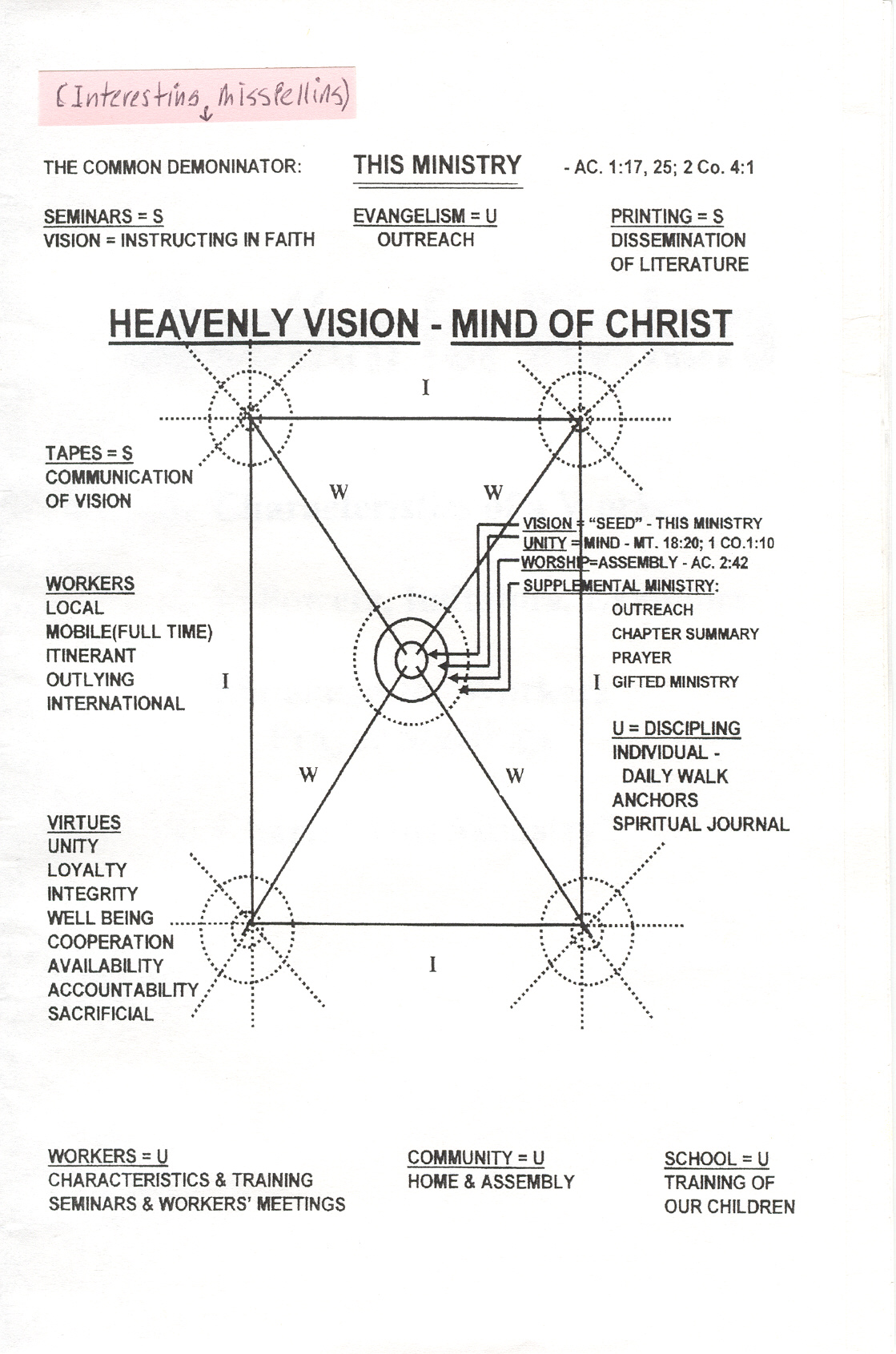
Once a month the Workers in Fullerton were joined by the Workers from outlying Assemblies, coming from as far as San Luis Obispo. A joint Workers meeting in Fullerton had about 50 people in attendance. Once a month there was also a joint Workers meeting in Chicago, with Workers coming from Nebraska and Missouri, as well as Illinois. Once a year there was a Workers Seminar, held in Colorado, which was attended by all the Workers worldwide with as many as 120 to 140 people in attendance.
Marguerite Harrison
By 1972, George was distancing himself from Sister Harrison. He was very upset that she did not agree with some of his ideas, such as head coverings. But he was outraged that she told people she had given George all his contacts in Europe. He made rules to restrict who she talked to and what she could talk about. Of course, she had known these people for years before George ever came on the scene.
This attempt at control did not escape the notice of her friends. It soon escalated into a big issue. She was reprimanded and humiliated in Workers' meetings. Ultimately Marguerite Harrison, broken-hearted, was forced out of George's ministry. Her friends in the US and Europe were alarmed, and most of them withdrew from George. But they had listened respectfully long enough to establish George's credibility in our eyes. By the time they dropped off, George already had things rolling.
Several Assemblies had been established, hundreds were coming to Fullerton four times a year for seminars, students were coming to Bible studies on several college campuses.
How the Assemblies Developed
Because of adhering to the early Plymouth Brethren principle of no formal training, all the Workers and Leading Brothers received their training only from George and Betty They were all at least twenty years younger than the Geftakys', and most of them came into the Assemblies when they were college age, having had very little or no previous Christian experience. There was no one in the Assemblies who was George and Betty’s peer in any way.
Consequently, although plans and problems were discussed by leading brothers and Workers, decisions were deferred to George and Betty’s approval. The early Plymouth Brethren stance on rejecting the formal churches was strongly continued in George’s teaching, so that there was no communication at all with mainline Christianity. "The Assemblies" became a completely closed system.
Controlling Authoritarianism
Along with this isolationism, a very tight enmeshment of "the saints" (as Assembly people referred to themselves) with each other developed. George and Betty overtly assumed the roles of "Mama and Papa", and taught the Workers to look upon themselves in those roles as well. A look at how Bob Jones University, Betty's college alma mater, functions in the role of parents with their college kids, goes a long way to explain the Geftakys' outlook. From that vantage point, they developed extensive control on people’s lives, with no one in a position of authority to challenge the doctrine, the directives or the procedures that came down from them.
One example of this is the area of finances. All donations were accepted only in cash; all the donations exceeding local expenses in each assembly were sent directly to George and Betty by money order; there was no accounting to anyone, and since the money was given in cash, and received directly by George as personal gifts, there was no accounting to the IRS.
Communal living was strongly encouraged, in the form of "Brothers Houses" (and later "Sisters Apartments" and "Training Homes"). These were homes with a married couple in charge, who usually were Workers. Several single men lived with them in order to be trained. The couple minutely oversaw their schedules, chores, finances, relationships, assembly involvement, attitudes, etc.
There was no dating in the assemblies; two people might "spend time" together under the direction of a leading brother. There were mothers meetings in which young mothers were instructed in the discipline of their children, and were paired up with Workers to be accountable.
The teaching that believers can become "overcomers" was a very strong motivation to the people to submit to the control.
George added further incentive by teaching that those who failed to overcome would forfeit their inheritance in Christ for eternity. Leaving the church that followed the New Testament pattern was one sure way to eternal forfeiture.
What Kept People From Leaving
Several factors combined powerfully to keep people in the assembly:
- They were cut off from all other perspectives of Christianity, and had taken George and Betty Geftakys as their sole authority, so that there was no objective basis of truth to be appealed to.
- They believed that if they left they would forfeit their eternal inheritance in Christ.
- They enjoyed and even needed the close interactions of the assembly family, which they were convinced they would not find in other churches.
- They weakened ties to their extended family, and cut off all friendships outside the assembly, either because of disagreements over assembly doctrine, or because of being too busy. Therefore, if they were to leave, they would have found themselves alone.
- They believed that the assembly way was the only right way, and so even if they were to leave for personal reasons, there would be no place to go.
- Because formal training was not necessary, many of hoped to attain to positions of influence and leadership in the Assembly, which was not likely to happen in mainline churches.
Some Did Leave
Over the years many people did leave, however. And of course, new people were recruited from the college campuses and took their place. People left for many reasons--some people left because they began to see that something was wrong, others left because they just couldn't take the pressure any longer. Steve and I left in March, 1990, after months of pleading with George over the excommunication of our son.
After we left George's ministry we contacted one of the Brethren assemblies that George was formerly involved in and learned that George had been a problem in their midst as well. If we had known his history from the outset, we would probably not have gotten involved with him nor commended him. (I say "probably" because one doesn't really know the full depth and twists of one's own motivations. Being desperate sinners like everyone else, we might just have plunged ahead anyway.) Those who formerly knew George did not warn anyone about him, and as a result great injury was done to many precious souls. We don't want to repeat that mistake and that is one of the reasons we maintain this website.
How the Assembly Movement Imploded
David Geftakys' Domestic Violence
In November, 2002, Brent T. in San Luis Obispo began this website to expose long-standing spousal abuse by the Geftakys' son, David, a worker and leader in several Assemblies over the years. Evidence showed that George and Betty Geftakys had known about it since the beginning, and allowed David to remain in leadership. They covered up the abuse, and failed to protect their daughter-in-law and grandchildren.
In 1996, David beat his oldest daughter, Rachel, causing permanent injury. She obtained a restraining order against him. George and Betty could no longer keep the situation completely quiet.
Leading Brothers in the Fullerton and San Luis Obispo Assemblies tried several times to persuade George to remove David from leadership and to provide counseling for him. George prevented any effective intervention, and continued to allow David to remain in leadership. In 2000, Judy left David, fleeing in fear for her life. George allowed David to remain in good standing in the San Luis Obispo Assembly, against the protests of some of the local leaders.
During the following year, 2001, almost half the people left the San Luis Obispo Assembly over the cover up, David's special treatment, and the lack of protection for Judy and the children. When this website was launched to expose the truth, George Geftakys pleaded ignorance about David's behavior, refusing to repent of covering it up.
The Role of the Assembly Teens
The following analysis of the role of Assembly kids in the crumbling of the Assemblies was posted by "Jem" on the Assembly bulletin board in February, 2006:
The role of the teens in bringing down George was messy. It wasn't as neat and clean as the websites. But they had a similar effect in exposing the system.
As "the saints" kids grew up they started asking questions. This began happening in the 1980's in Tuscola and the Midwest, and on the West Coast in the few families, such as the Irons and the Maddux's, who had older kids. Many of these kids left fellowship and sometimes their parents wisely followed.
But by the mid-1990s there was a mass coming of age on the West Coast. This led to the formation of the Teen Teams, which were intended to be a sort of corporate indoctrination of the teens. But when you get that much energy in one place things can go horribly wrong.
The teens did what we were all trained not to do: they didn't take pat answers. This resulted in their parents having to think. When their parents couldn't come up with logical answers they turned to leadership, who came up with new twisted responses to simple questions.
The teens were not as effected as their elders by the "code of silence" and they did talk among themselves about what seemed whacked. While their elders were unwilling to see and face the issues, the teens were more than willing.
While we were all ignoring that elephant in the room, they would tug on our sleeves and say, "Dude, did you notice that elephant over there? How come know one is talking about it? How come no one is cleaning up the mess?" Many of them said, "I'm so outta here" in one way or another. Some physically, most all emotionally. I won't say spiritually, because we were so messed up I'm not sure if any of us really knew what that meant.
While among their elders there was an unwillingness to honestly face one's own sins, which leads to willingness to overlook another's, the teens were not unwilling. Some of them, sadly, were boldly sinning and more than willing to point out everybody else's sins. I believe some desperately wanted "clarity of vision," but could see that they were in a Pharisaical, hypocritical system. By the time everything hit the fan, the questions of our children had created enough unrest that people were finally willing to see the obvious.
When all this stuff about David started to become known, and then was followed hard by George's bizarre response and ultimate unmasking, the teens were not in the least surprised. The grown ups were shocked, but the teens sort of knew it all along. We just didn't listen for a long time because we knew so much better than they did, and besides, didn't they wear their sins all on the outside?
It wasn't clean, it wasn't pretty, but the teens were a force to be reckoned with.
George Geftakys' Immorality and Excommunication
In early January, 2003, George and Betty left the Fullerton Assembly while the leaders were attempting to discipline him and bring him to accountability. During the following week George's sexual abuse over the years of at least three young women in the Assembly came to light. On January 19, 2003 the leaders in the Fullerton Assembly excommunicated him from the group.
Disbanding of Many Assemblies
The situation blew up from there and really broadened. As people began talking, things that had not previously been exposed began coming to light. Puzzle pieces began to fit together:
- the financial secrecy
- the way the Geftakys' had treated people over the years
- George's expressions of narcissism
- the lack of effectiveness on the part of the leaders
- their incompetence in mishandling the matter of David Geftakys' domestic violence (as ministers they were mandated reporters of suspected child abuse)
There was great anger and indignation, not only against George Geftakys, but also against the leaders who had not stopped his wicked behavior over the years.
The collusion of the leadership to enforce a code of silence became evident in a shocking way.
Real life suddenly broke in on the isolated community called the Assembly. Assembly people were devastated by the betrayal. Many people left the Assemblies immediately, including some Leading Brothers and Workers. Local Assemblies dwindled, and many disbanded entirely during that year.
Status of Continuing Assemblies in 2005
At the end of 2005, there were still about fifteen continuing Assemblies. They are divided into two groups. Four of these Assemblies remain loyal to George and have not read the letter of excommunication. The leaders in these groups continue to exercise excessive control over their members. Members are forbidden to read this website or speak to former members. Essentially there seems to have been no change. George continues to teach weekly Bible studies and has held at least one seminar for these groups. These four Assemblies are actively recruiting new members, and deceptively concealing their history with George Geftakys.
The second group have renounced George and have made some efforts to change. Further reading, Status of Former Assembly Groups and Leaders.
Current Concerns
Status of Former Leaders in 2005: George Geftakys
 George
Geftakys has not admitted nor repented of his immoral behavior, nor of
failing to stop his son's domestic violence. He has resumed conducting
weekly Bible studies, and has given at least one seminar to the four
Assemblies still loyal to him. He is positioning himself to begin all
over again, after being disciplined by the elders of three churches and
the majority of his own Assemblies for immoral and unethical behavior.
George
Geftakys has not admitted nor repented of his immoral behavior, nor of
failing to stop his son's domestic violence. He has resumed conducting
weekly Bible studies, and has given at least one seminar to the four
Assemblies still loyal to him. He is positioning himself to begin all
over again, after being disciplined by the elders of three churches and
the majority of his own Assemblies for immoral and unethical behavior.
George Geftakys is dangerous because he is a false teacher. Aspects of his teaching are seriously inconsistent with the Gospel as it is understood in most Christian churches. Any group that still receives teaching from him will be controlling, and have cultic characteristics. He is also a danger to unsuspecting women. In a the cultic environment his immoral advances are not easily discerned or rebuffed. Single women, daughters and visitors in his four loyal Assemblies are at risk.
To the best of our knowledge, George and Betty Geftakys still minister in the Assemblies in San Francisco and Sacramento, and are being financially supported by them. The leaders of these Assemblies do not accept George's excommunication, and have not allowed the members to hear the charges against him. The people are told not to read this website. They Assemblies are actively engaged in recruiting new members. They appear to be perpetuating the cultic practices of the Assembly--information control, elitism, deception, false teaching. In San Francisco, George appears to be grooming Scott Testa to carry on the ministry.
Status of Other Former Assembly Leaders in 2005
Some former Assembly leaders who are no longer in association with an existing Assembly, but who are becoming involved in other churches, are also a matter of concern. Some of these men are still motivated by the elitist Assembly mindset, feeling that they know the Bible better and have greater vision of what the church should be than other Christians. They seek positions of influence as Bible study leaders, Sunday school teachers, mentors, even as advisors to pastors.
They are often well-received, because they appear to be very spiritual, model Christians, who are more than willing to take on responsibility in the church.
But unless they have humbly mended the relationships they have left behind, and have corrected their doctrine of salvation and the church, they will pass on to others the twisted interpersonal dynamics and the performance-based doctrine of the Assembly.
These are men who did not leave the Assembly because they discerned error. They left because their congregations dwindled after the revelations of G. Geftakys' moral failure. Some of these leaders attempted to keep their diminished Assemblies going anyway, but were forced to step down by the members. Two examples are Omaha, NE, and the San Fernando Valley, CA. They did not understand that their leadership was harmful.
These men, like leaders in existing Assemblies, do not see the problems with the Assembly. For the most part they have been unrepentant for their part in the cultic system and the personal damages they have caused to individuals.
Former Assembly leaders need to be learners, not teachers, for a long time to come. Pastors need to become informed about the development of the Assembly, the errors, and the cultic problems, to protect their own flocks. Wise pastors might also be able to help these men recover.
Existing Assemblies That Do Not Associate With George
The fourteen continuing Assemblies that have severed their relationship with G. Geftakys are also a matter of concern. They may be sincere, but they also appear to be perpetuating many of the same negative characteristics--false teaching and cultic practices-- as the Assemblies that still associate with George. These men also do not seem to see that there were other major problems in the Assemblies besides the behavior of George Geftakys. Some of them have issued vague statements of repentance for their part in perpetrating the cultic practices and false teaching of the Assembly. But for the most part they have been unrepentant for the personal damages they have caused to individuals.
These Assemblies are also still conducting outreaches, such as Bible studies on college campuses and concerts by Remedy Drive, the Assembly band. Most of them are very secretive about their previous association with the Geftakys ministry. None of the Assemblies welcome former members, such as ourselves, who are openly critical.
The doctrinal errors and cultic practices of the Assembly have been deeply ingrained in former leaders and members. Many of them are still unaware that these beliefs and practices are false and damaging. Most have not read the material on this website, and shun contact with those who have. These people are to be pitied because they are still in bondage, and they are dangerous because they continue to spread the poison. They need solid Bible teaching, encouragement and positive involvement with other believers.
For the first 12-18 months after the general dissolution in January, 2003, there was a clear distinction between the continuing Assemblies that were loyal to George, and the others who had severed their association with him. However, the line seems to have blurred, as folks have attended weddings of former and current Assembly members in both camps. West LA, particularly, may even be in transition back into the fold.
There are further details about the Geftakys' and the Assemblies in the articles "An Open Letter to Assembly Folks", and "Kristin's Story".
Addendum: A Word of Warning 2005
Steve Irons has this to add:
"I Tim 3:2 tells us that the first qualification of an elder is to “be above reproach” George had already disqualified himself from any kind of public office with his sad history among the conservative open Plymouth Brethren. The elders at Grace Bible Chapel and Westmoreland stood against him and did not give him a public office. The first and last God-ordained bulwark against sin in the church is the government of the local church, the elders. When that fails, there is no recourse to a higher authority, at least here on earth.
"Now that we all know better, how sad it would be to allow George to continue to have a public ministry when so many elders in the past, and now more recently in Fullerton, have made it crystal clear (with more than sufficient cause) that George has brought scandal to the church, is not above reproach, and that he is no longer welcome to preach in their Assembly. The other Assemblies need to take heed."
See also Chuck Miller's Appeal to Assembly Leadership.
